
Aging & Disability
Are you looking for aging or disability-related resources for yourself or a loved one? Find local resources for respite care, senior ride programs, and Maryland Access Point (MAP) offices that help Marylanders navigate services with individualized counseling.


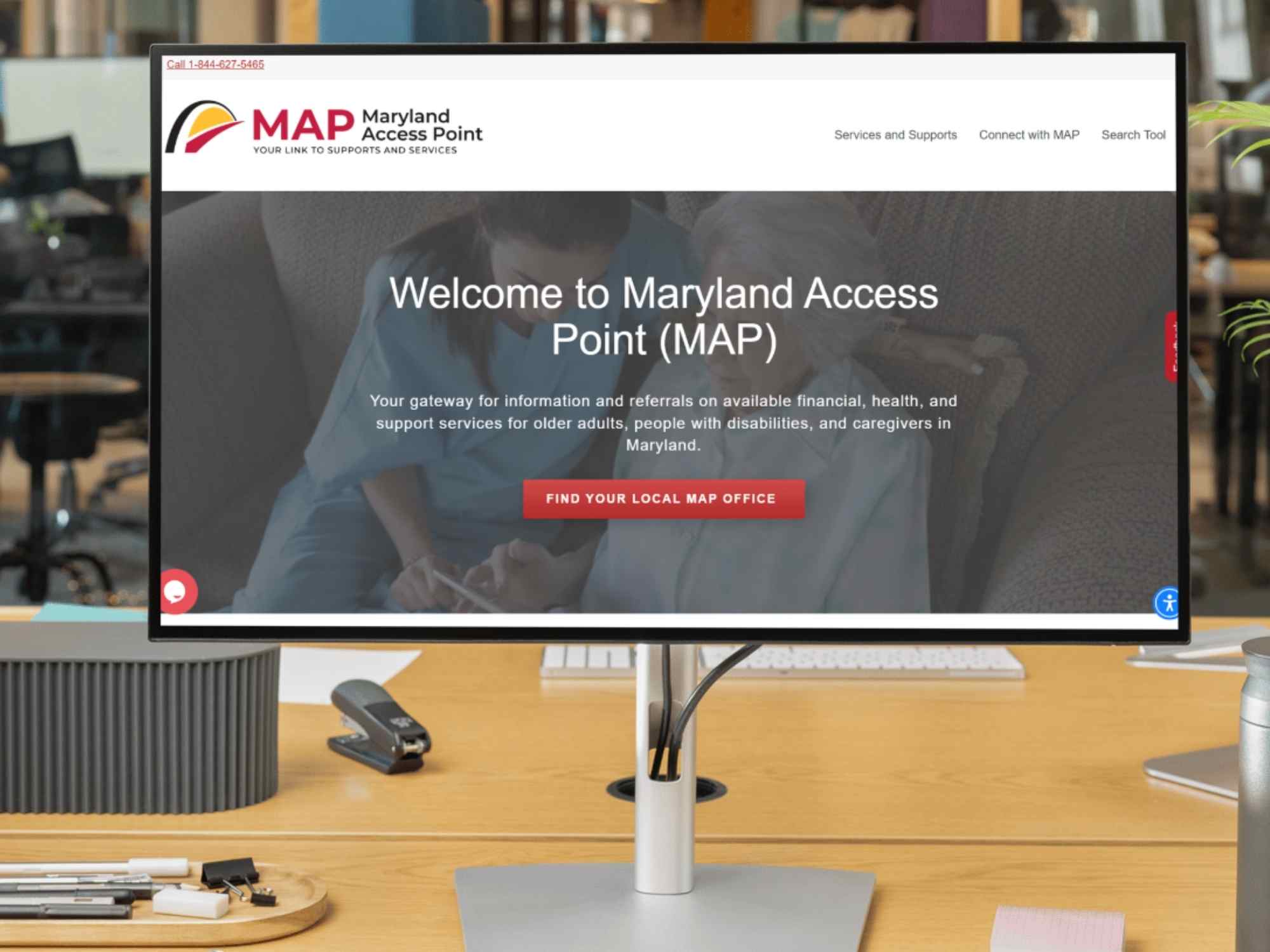
What Is MAP?
Maryland Access Point (MAP) offices serve as a single point of entry for older adults, people with disabilities, and caregivers. MAP provides information and referrals for financial, health, and support services. Counseling is also available.
The 211 Community Resource Database integrates into the MAP website to connect Marylanders to resources and support, and the MAP Help Line is managed by the Maryland Information Network, which powers 211.
There are three ways to connect with MAP.
- You can search for resources.
- Find information on the MAP website.
- Call the MAP Help Line at 1-844-MAP-LINK (1-844-627-5465).
There are 20 local MAP sites throughout Maryland, offering long-term support services and community resources to individuals in need. By calling the MAP Help Line, you'll get connected to information, resources, and local support if needed.
Aging Text Messages
In addition to connecting with resources, you can also get ongoing, informational text messages with resources and tips.

Text MDAging to 898211.
211 Maryland offers text message alert programs which provide region-specific resource information or provide disaster alerts. Text STOP to the same number to unsubscribe. Full SMS terms at https://211md.org/sms/ will also apply.


Find Aging & Disability Resources
Find resources nearby in the Maryland Access Point resource directory.

Empowering Caregivers
The Maryland Department of Aging has a suite of tools to support older adults and people with dementia.
Both are free and available to help empower caregivers with information and resources.
Memory Care Checklist
The Johns Hopkins Memory Care Checklist is a new self-service tool that can help families caring for someone with cognitive challenges identify needs, access information, and connect with supports.
The Checklist guides family caregivers through a series of questions impacting the health and well-being of the person with memory loss and the caregiver(s). Then, the system prioritizes needs and provides a Personalized Report that guides the caregiver on what they need to know and where to go for help.
The report links directly to resources on the MAP website, which is integrated with the 211 Community Resource Database. The Checklist was developed through a partnership with the Johns Hopkins University School of Nursing, the Maryland Department of Aging, and the Maryland Information Network, which powers 211.
Screening Tool
If the patient doesn't have a diagnosis, the AD:8 Cognitive Screening Tool compares signs of normal aging to potential signs of mild cognitive impairment. It's only 8 questions, and is designed to identify early signs of cognitive impairment. The AD:8 is a preliminary step before talking to your healthcare provider, and is not a diagnostic tool.
The AD:8 was developed by Washington University.
Caregiver Support
Nearly one in five adults in the United States cares for a senior, an ill adult, or a child with special needs. It’s important to remember to take care of yourself in addition to your loved one.
There are programs that can help lighten your load. From Meals on Wheels to Senior Ride Programs and Respite Care, there are numerous resources available to support seniors and their caregivers.
Respite Care
Respite care can be another source of support. These programs provide a brief period of rest or relief by offering temporary or intermittent care in the home or in community settings/facilities.
Respite care programs can give caregivers time to attend to their own needs, knowing their loved one is being cared for. Often, respite care is paid privately, though in some cases, insurance may help cover the cost.
Additionally, grants and subsidies may be available. Ask about these when contacting the respite care agency.
We've linked respite care resources throughout Maryland on the Maryland Access Point website.

Caregiver Support
The Caregiver Action Network offers a toolbox of videos, resources, and tips to support caregivers.
If you are a new caregiver seeking to understand the immediate needs of the individual’s illness, the Family Caregiver Alliance provides information on what to expect for common diagnoses, including Alzheimer’s Disease, dementia, and stroke.
Search for caregiver support with the Maryland Access Point Search Tool.
Support Groups
Dealing with the stresses of caregiving and the emotional impact of having a loved one with an illness, injury or disability can easily become overwhelming.
It can be very useful to connect with other caregivers who understand the situation and may be dealing with very similar thoughts and emotions.
The Maryland Family Caregiver Support program also provides counseling and education, information, respite care, assistance, and supplemental services.
Local support groups may also be available.
Call 211 for help.
Report Abuse
If you suspect a senior is being abused, based on warning signs, report the abuse.
Call 1-800-917-7383 within the state of Maryland or reach out to your local Department of Social Services, Adult Protective Services office.
Senior Call Check
Maryland’s Department of Aging provides free, automated check-in calls with seniors. The program is called Senior Call Check.
During a regularly scheduled time, a call is placed to the senior. If the individual does not answer, the call will be placed two more times.
If the senior can’t be reached, an alternative person will be contacted. That person is selected at the time of enrollment.
Any Marylander with a landline, who is age 65 or older, can sign up for the free Senior Call Check program.

Find Used Medical Equipment
If you're a senior or know one in need of durable medical equipment, like a cane or walker, you can get support from the Maryland Durable Medical Equipment Re-Use program. The donated equipment is sanitized, repaired, and refurbished.
The Maryland Department of Aging discussed the program on Episode 16 of What's the 211 podcast. Amanda Distefano explained that the program uses occupational and physical therapists to identify the right fit for each individual. That way, the equipment is not too large or too small for a person.
You can also donate equipment to the program.
If you need medical equipment or assistive technology temporarily, you can utilize a loan program throughout the state.
Adult Changing Tables
It can be difficult to provide personal care to an adult in public if a restroom doesn't have adequate facilities. A bathroom may have a diaper changing station, but that won't work for an older child or adult.
A new law requires universal changing facilities in certain public buildings, like a park, recreation center, bus station, or airport. They're required for public buildings built after October 1, 2022, and in buildings where a public restroom is added or an existing one is substantially renovated.
It's the facility's responsibility to notify 211 about the accessible changing table so the public can find it.

Dial 211
Talk to a caring and compassionate person 24/7. They can also connect you to resources.
Disability Benefits
Disability claims can be physical and/or mental. Processing some disability benefit applications can take a long time, and you may be eligible for other benefits while waiting. There are programs available for both short-term disabilities (less than one year) and long-term disabilities (one year or longer).
Here are some of the largest programs to help people with disabilities be financially independent. However, other sources of income do exist. Help is sometimes available through organizations designed to help people who have a certain condition or health status. Do not assume that you are not eligible for benefits without first discussing your situation with someone knowledgeable in the field of disability rights.
In addition to Maryland Access Point which helps Marylanders over age 18 with a disability, along with their family and caregivers, there are other resources and disability benefits available to help Marylanders.
Temporary Disability Assistance Program (TDAP)
TDAP provides limited cash grants monthly to low-income, single disabled adults.
The Temporary Disability Assistance Program is intended for use during short-term disability or while an individual is waiting for approval of a federal disability benefit.
The money can be used for emergency needs such as rent, prescriptions and medical expenses.
If a doctor certifies that the disability is likely to last at least 12 months, the person is also required to apply for disability benefits through the Social Security Administration in order to continue receiving TDAP benefits.
The program is applied for through the Department of Social Services. Click to find your local office.
Supplemental Security Income (SSI)
Social Security administrates Supplemental Security Income (SSI), disability benefits and Medicare.
SSI provides a monthly payment to individuals with low-income and few assets, who are over 65, blind, or disabled.
To be considered for SSI benefits, the disability must be expected to last for at least 12 months.
It’s important to note that someone may still be able to work and receive income from employment while receiving SSI benefits.
Children under the age of 18 who are blind or disabled may also be eligible for SSI.
Call the Social Security Administration at 1.800.772.1213.
Social Security Disability Insurance (SSDI)
SSDI provides a monthly payment to individuals with a disability that is expected to last at least 12 months or result in death.
Social Security Disability Insurance is also run by the Social Security Administration.
Eligibility for benefits and the amount of benefits are in part determined by the age at which the person became disabled as well as the length of their work history. The Adult Disability Checklist covers the information and documentation that you’ll need to apply for benefits.
To apply for Social Security Disability Insurance, contact the Social Security Administration at 800-772-1213.
Social Security Survivor Benefits
The Social Security Administration also administers survivor benefits, including a lump sum death payment for survivors of those insured by Social Security and benefits for children who are under age 18 or disabled and have had one or both parents die.
Local Social Security offices help individuals apply for benefits or file appeals if they’ve been denied benefits. These offices provide information on eligibility and the rights of applicants/recipients.
Benefit Programs

Social Security is a retirement benefit program administered by the Social Security Administration that provides monthly cash payments for people age 62 and older who are fully insured.
Workers may retire at age 62 and receive a reduced benefit, or may wait until age 65 and receive a full benefit.
Benefit amounts vary based on several factors. Click here to estimate your benefits.
Apply online for Retirement Benefits or call a local office to discuss your options.
Grandparents who provide kinship care
Some grandparents find themselves caring for grandchildren due to a family hardship with the child’s parent. This is referred to as kinship.
Kinship care is a full-time arrangement where the child lives with a relative, like a grandparent or other family member.
These arrangements can happen informally or formally.
With informal kinship care, legal custody is not required. The grandparent cares for the child due to a serious hardship like an illness, substance use, Active Military Duty, death of parents, incarceration or abandonment.
Kinship care is a good choice for the child, but it may not be the best choice for your family, especially if you’re in retirement.
Kinship Help
While there are many resources for kinship grandparents, it’s not without it’s challenges. It can strain relationships and impact your financial and personal situation.
Kinship navigators can help you navigate these challenges and provide resources.
You will be able to apply for benefits to help with food, child care, health insurance and other financial needs.
Text Support
211 Maryland, in partnership with the Maryland Department of Human Services, also provides text message support for kinship caregivers.
Get encouraging messages of support along with text messages with information on community resources.
Text MDKinCares to 898211 to sign up.
211 Maryland offers text message alert programs which provide region-specific resource information or provide disaster alerts. Text STOP to the same number to unsubscribe. Full SMS terms at https://211md.org/sms/ will also apply.
Related Information
-
Episode 16: A Conversation with Maryland Department of Aging
On What’s the 211? podcast, Maryland Department of Aging talks about its programs, including those with 211.
-
Medicare Benefits
Default Page HeadingMedicare is a government health insurance program, that provides assistance to people ages 65 and older, people under 65 with certain disabilities, and…
-
VA Medical Benefits
Many Veterans are eligible to have some or all of their health care provided through the VA system. Many factors go into determining someone’s eligibility…
-
Get Help with Medical Bills and Expenses
Do you have a medical expense that you can’t afford? You are not alone. Maryland and national organizations may be able to help offset some…




explore assistance programs
Learn about benefit programs and how to connect with support.


Housing
Rental payments, eviction prevention, homeless shelters.

Utilities
Electric, gas, and water bill assistance programs.

Taxes
Free tax preparation help, software, tax credits
explore assistance programs
Learn about benefit programs and how to connect with support.
Utilities
Electric, gas, and water bill assistance programs
Housing
Rental payments, eviction prevention, homeless shelters
Taxes
Free tax preparation help, software, tax credits